


Santa Cruz Hightower vs. Bronson in Review
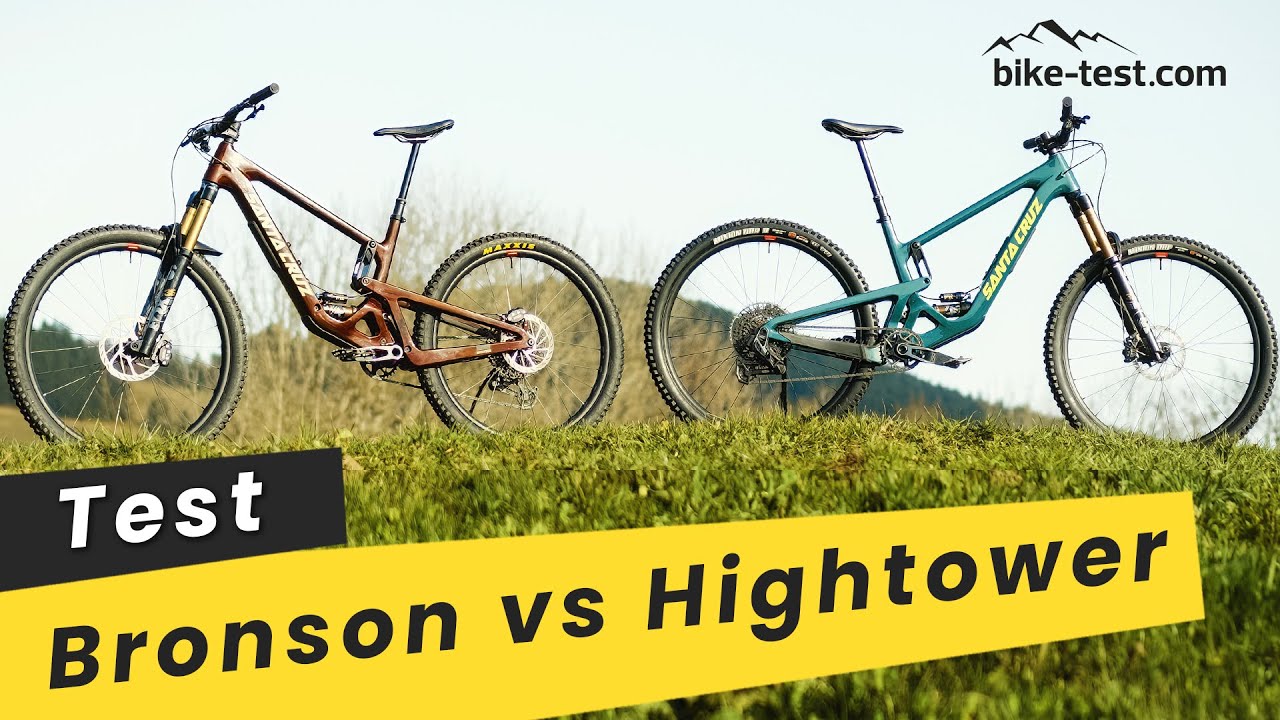
The new Santa Cruz Bronson and Hightower not only share the same travel. The bikes also share the same front triangle. Where the difference lies and which bike is the better one, we reveal in our back-to-back test.


Who says Santa Cruz, also has to say wallet.
The Hightower in our test is presented in the exclusive XO AXS spec for €8799. For that kind of money, you get a Fox Factory Kashima suspension, consisting of a 36 Grip2 fork up front and a Float X shock at the rear.
Apart from the Fox suspension, most of the components come from SRAM. Shifting is handled by a XO Transmission drivetrain and braking by Maven Silver brakes. In terms of specification, both bikes are identical – except for the tires and the saddle.
At 14.9 kg, both bikes are not lightweight. The Bronson offsets its smaller rear wheel’s weight advantage with heavier tires for added puncture protection.
In addition to the hardware, Santa Cruz riders get the peace of mind of a lifetime warranty and the promise of being able to replace every small part individually in the worst-case scenario.


How do they climb uphill?
For a bike weighing almost 15 kg, the Hightower pedals uphill surprisingly unobtrusively. Clearly, it’s no longer the summit conqueror and sprint ace that older 2nd generation Hightower models once were. Compared to the 3rd generation, the climbing performance has remained comparable. And compared to other bikes in its class, both the Hightower and the Bronson are willing companions for the ascent. The rear suspension of the Hightower stays pleasantly calm, barely sapping pedaling energy even in the open mode.
Engage the Climb-Switch of the Fox Float X shock, and the rear suspension is locked out. The difference is noticeable, which is why we used the Climb Switch actively—even though it’s positioned low, requiring a stretch down to reach.
However, when the trail to the peak veers off the beaten path and blocky sections have to be tackled even during the uphill, we often wished for a bit more support from the rear. The inevitable weight shift that steep uphills with steps bring about causes the rear to squat a bit. This might also be due to the reduced anti-squat, which has been adjusted down on the new Hightower in favor of a finer responsiveness.


Sibling rivalry in the uphill
Since the Hightower shares the same main frame with the Bronson, we set the two bikes against each other in a head-to-head duel. The riding position on the Hightower feels slightly more upright—it feels as if you’re sitting higher. With nearly identical geometry data, the kinematics must be responsible for this.
Even though the main frames are the same, the rear suspension and kinematics are different. The Bronson has an alternative leverage ratio and different anti-squat to favor better responsiveness. This causes the bike to be less stable around the SAG point and to dive into the travel with increasing weight shift to the rear.
With the same setup and geometry, you are positioned more centrally over the bike on the Hightower during climbs, allowing you to apply pedal pressure more efficiently. The fact that the Hightower also rolls better is solely due to the thinner EXO casing on the Maxxis tires. The Bronson, prioritizing better puncture protection at the expense of rolling properties, features a thicker EXO Plus casing.


Jekyll and Hyde – the two faces of the Hightower
The name Santa Cruz stands for durability and service-friendliness, but above all, for fun – fun on the downhill. Those who flick the bike like a whirlwind from side to side on the trail, pop off every edge, and shred down the hill with enthusiasm will have a true joy with the Hightower. The Hightower’s favorite habitat is flowy trails that allow for playful maneuvers.
Even in technical terrain, the Hightower can convince – at least as long as the terrain is so technical that you can’t just bomb through at full throttle. With a cautious but active riding style and solid technique, the Hightower shines with its precise and direct handling – perfect for playfully mastering tricky trail sections.
When things get serious on the downhill, the rear suspension feels a bit harsh and could sit more plushly on the trail. It seems the impeccable uphill qualities take a toll on the downhill performance.
Luckily, the Hightower’s geometry concept hits the mark, so the balanced geometry can somewhat mask the rear suspension’s performance. The spec is impeccable, inspires confidence, and feels rock-solid. Only the tires, with their EXO casing, reach the limit of their puncture resistance in harsh terrain with aggressive riding.


Is the Bronson the better all-rounder?
In a head-to-head comparison with the Hightower, the Bronson feels significantly more planted on the trail—so much so that it delivers a wow factor in terms of comfort. The rear suspension handles fast, sharp hits better and builds significantly more traction. Additionally, it feels like you’re positioned deeper in the bike, which also contributes to the sense of security.
The Bronson is definitely the better descender. If you have to choose between the two bikes, our advice is clear: make slight compromises in uphill performance and opt for the Bronson for better downhill performance.

Details on Frame and Equipment
The fierce Maven brakes are a beacon of hope on the horizon of SRAM brakes for me. While the Guide, G2, and Code have always felt too weak to me, the Maven swings to the extreme opposite. There’s endless power here. Santa Cruz leverages the force of the Maven and pairs the fierce stoppers with 180mm rotors. Where you would usually cry out for larger rotors with almost any other brake, the Maven earns top marks with 180mm discs. The brake presents itself with reliable stability and surprises with excellent modulation thanks to the smaller rotors. Smart move, Santa Cruz.
For a long time, Santa Cruz bikes had seat angles that were simply too slack for me. Due to my inseam length, I have to raise the saddle quite high, which often positioned you too far back on many Santa models. However, Santa has updated its geometry concept with steeper seat angles on this front. The seat angle measures 77.9° in the low setting.


He who compares, knows more
If you want to take a detailed look at the differences in geometry between the Bronson and Hightower, you can do so with our comparison feature. Both models cost the same. We also have a standalone review of the Bronson V5 available.


Advantages of the Hightower
- good all-rounder
- climbs well despite 14.9 kg
- playful in handling
Cons of the Hightower
- relatively expensive
- Bronson performs better in extreme terrain
Conclusion on the showdown between Hightower and Bronson
The Hightower is an all-rounder whose greatest strength lies in its forward momentum. The bike climbs with determination and impresses downhill with steering precision and playfulness. On technical trails, the Hightower can be maneuvered with pinpoint accuracy—as long as you shift down a couple of gears in terms of speed. The faster and more intense things get, the softer the Hightower’s knees become. That’s why the shredders in the Santa Cruz fan community are better off with the Bronson, as this bike pushes the limits downhill in a different way. The Hightower, however, is a great bike for tech-loving trail riders. Santa Cruz offers both options with 160 mm travel in the fork.


